At ProCalcs
Oversized commercial cooling systems are one of the most common — and expensive — mistakes in HVAC design. They short-cycle, fail to dehumidify, cost more upfront, and wear out faster. The Radiant Time Series (RTS) method is the ASHRAE-recommended way to get commercial cooling loads right — by modeling how heat actually enters a building hour by hour, and how thermal mass delays when that heat becomes cooling load.
ProCalcs delivers RTS cooling load calculations for light commercial projects nationwide, in accordance with the ASHRAE Handbook of Fundamentals. Most projects are completed within 3–5 business days. Our commercial scope is limited to buildings up to 99 occupants and 15 tons per unit.
Radiant Time Series (RTS) Cooling Load Calculation Method
What are the benefits of using the RTS method for your commercial project?
- ASHRAE-recommended simplified cooling load method since 2001
- Calculates hour-by-hour cooling loads across the design day
- Captures thermal mass and time-delayed radiant heat gain
- Identifies the true peak hour and peak month for the system
- Replaces older methods (CLTD/CLF, TETD/TA, transfer function)
- Strong fit for buildings with high solar exposure or heavy construction
- Accepted on projects where ASHRAE-based calculations are specified
RTS Method for Light Commercial Buildings
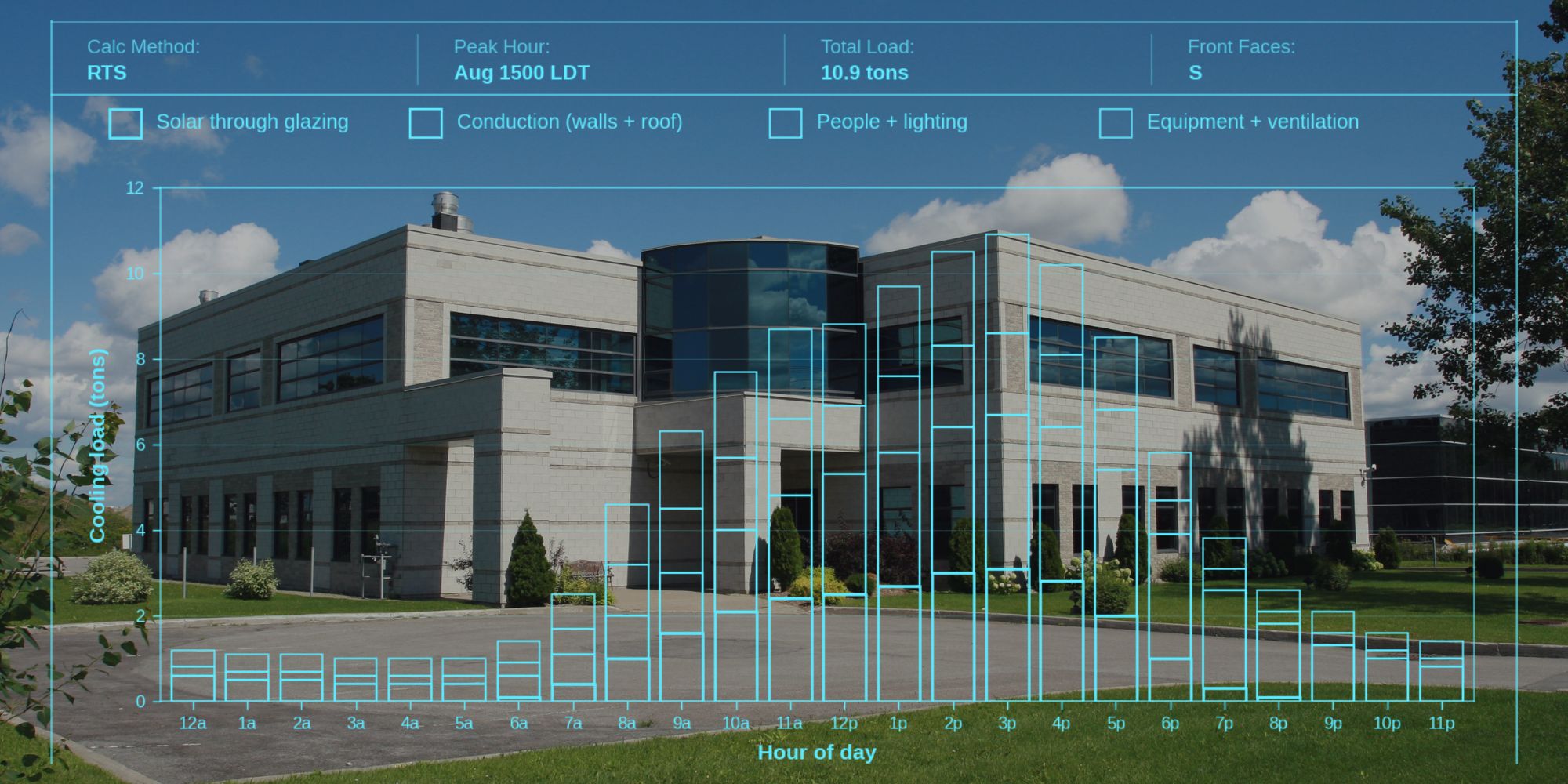
The Radiant Time Series method was introduced in the 2001 ASHRAE Handbook of Fundamentals (research completed in 1997) and effectively replaced the older simplified methods — CLTD/CLF, TETD/TA, and the transfer function method — with a single, more accurate, non-iterative procedure derived from the full Heat Balance method.
What makes RTS different is that it explicitly models when heat becomes cooling load. Heat gains don't show up as cooling load instantaneously — radiant heat is absorbed by walls, floors, and furniture and re-released over time. RTS uses pre-calculated factor sets to capture that delay, which is why it produces a realistic peak hour for the system to be sized to.
Ready to get started? Contact us online to receive your free estimate on our load calculation services.
How the RTS Cooling Load Method Works
Per the ASHRAE Handbook of Fundamentals, the RTS procedure runs each cooling load component — walls, roof, windows, lights, people, equipment — through the same five-step sequence to produce a 24-hour load profile for the design day.
Step 1 — Build the 24-Hour Heat Gain Profile
Hourly heat gains are computed for every component of the building envelope and every internal source. For conduction through walls and roofs, Conduction Time Series (CTS) factors are applied first to account for the thermal lag through the assembly — so a heavy masonry wall responds differently from a lightweight wall with the same U-value.
Step 2 — Split Each Gain Into Radiant and Convective Parts
Every heat gain has two pathways into the space: direct convection to room air (becomes cooling load immediately) and radiation onto interior surfaces (delayed). ASHRAE tables provide the radiant/convective split for each gain type.
Step 3 — Apply Radiant Time Factors
The radiant portion doesn't become cooling load immediately — it gets absorbed by floors, walls, and furniture and re-released over time. RTS uses 24-hour Radiant Time Factor (RTF) series — separate sets for solar and non-solar gains — to spread that load across the day.
Step 4 — Sum Convective + Delayed Radiant for Each Hour
For each component, the immediate convective load and the time-shifted radiant load are added back together to produce that component's hourly cooling load contribution.
Step 5 — Total Components and Find the Peak Hour
Hourly totals across every component reveal the design peak — the hour, month, and conditions when the system has to work hardest. That's the number we size the equipment to.
RTS Method vs. Manual N — Which Should You Use?
Both are valid load calculation approaches for light commercial work. They come from different standards bodies and serve different project needs. Neither is "better" — they're different tools for different situations.
Choose RTS when:
- The engineer, owner, or project spec calls for ASHRAE-based calculations
- The building has significant solar exposure or large glazing
- The construction is heavy mass (masonry, CMU, concrete)
- Occupancy or internal loads vary significantly by hour
- You need to find peak load by month, not just peak design day
Choose Manual N when:
- The building department defaults to ACCA-based submittals
- The project is a typical office, retail, restaurant, or small mixed-use
- You need both block load and room-by-room outputs
- You want the most widely accepted commercial submittal format
Ready to get your RTS cooling load calculation?
Get Your Free QuoteCommon Questions About the RTS Method
What is the Radiant Time Series method?
RTS is a simplified hourly cooling load calculation procedure derived from the ASHRAE Heat Balance method. It uses two pre-calculated factor sets — Conduction Time Series (CTS) for the thermal lag through walls and roofs, and Radiant Time Factors (RTF) for the delay between when radiant heat enters a space and when it becomes cooling load.
Who developed RTS and when?
RTS was developed by Spitler, Fisher, and Pedersen with research completed in 1997, and was first published in the 2001 ASHRAE Handbook of Fundamentals.
Is RTS better than Manual N?
Neither is "better" — they're different tools. Manual N is the ACCA standard most building departments default to. RTS is the ASHRAE method used when hourly modeling, thermal mass, or radiant time delay matters more.
How is RTS different from the Heat Balance method?
Heat Balance is the most rigorous ASHRAE approach — full iterative calculations at every surface. RTS is a simplified, non-iterative version that's spreadsheet-friendly and accurate enough for the vast majority of light commercial sizing work.
What size of project can ProCalcs handle with RTS?
Our commercial scope covers buildings up to 99 occupants and 15 tons per unit. Projects beyond that scope typically require a licensed engineer's sign and seal — we can still do the design and load calculation work, and your engineer reviews and signs off on the final documents.
What types of buildings benefit most from RTS?
Light commercial buildings with high solar exposure, large glazing, heavy construction, or significant hour-by-hour variation in occupancy and internal loads — small offices, retail spaces, restaurants, mixed-use.
What information do you need for an RTS calculation?
Floor plans with envelope details, glazing specifications, occupancy and use profile, internal heat gains from lighting and equipment, ventilation requirements, and project location for design weather data.
How long does an RTS calculation take?
Most RTS calculations are completed within 3–5 business days. Larger or more complex projects may take longer.
Complete Your Commercial HVAC Design Package
RTS gives you the cooling load. The rest of the package turns that load into a permit-ready design:
- Manual N Light Commercial — ACCA-based commercial load calculations
- Manual S Equipment Selection — match equipment to the load
- Manual D Duct Design — size the ductwork to deliver the air
- Manual T Air Distribution — register and grille design
Ready to Get Your RTS Calculation?
Fill out the form below with your project details and a team member will reach out to you shortly to discuss your project.

Everyone at ProCalcs has always been very responsive and streamlined in their questions in order to provide our company what we need depending on the type of project. They have also been a key player in expediting the process when we are in a pinch! Thanks for all you do!
MYAH FARAONE
1/15/2020
Scott, Tom, and the rest of the team at ProCalcs are incredibly efficient, responsive, and accommodating! I just finished up my project with them and I have a feeling we'll do many more together.
EMILY HIRST
2/27/2019
Pro Calcs is punctual, and responsive, produces a high quality product at a value.
JOSEPH MCCARTY
3/19/2020