
AC Blowing Air But Not Cold? Here’s Why — and What to Check Before You Call a Pro
Quick disclaimer: This article is for general informational purposes only and is not a substitute for professional advice. HVAC systems involve electrical and refrigerant hazards. Always consult a licensed HVAC technician for repairs, and never attempt work you’re not comfortable performing. ProCalcs LLC assumes no liability for actions taken based on this content.
It’s the middle of summer, your air conditioner is clearly running — you can hear it, you can feel air coming out of the vents — but the house just won’t cool down. The air feels lukewarm instead of cold. It’s one of the most common (and most frustrating) home cooling problems, and the good news is that many of the causes are things you can check yourself in a few minutes, no tools required.
This guide walks through the eight most common reasons an AC blows air but not cold air, in the order you should check them — from the 60-second fixes to the ones that need a licensed technician. If you’d rather have an expert walk you through it, describe your exact symptoms to Ask Your HVAC Pro and get step-by-step help — including a camera diagnosis if you’re not sure what you’re looking at.
Table of contents
- The 60-second checks
- The 8 most common causes
- Why it won’t cool the whole house
- DIY vs. call a pro
- How much should the repair cost?
- FAQ
First, the 60-second checks
Short answer: Most “AC not blowing cold air” cases come down to three things — a wrong thermostat setting, a tripped breaker on the outdoor unit, or a clogged air filter. Check those first before assuming an expensive repair.
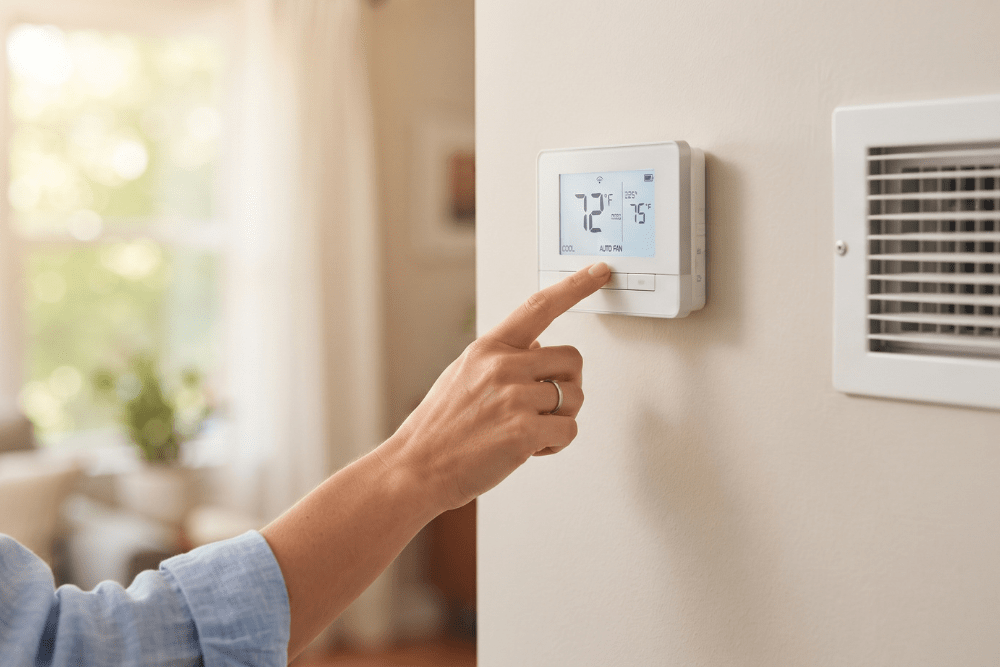
1. Check your thermostat settings. Make sure it’s set to COOL (not just “fan”), and that the target temperature is several degrees below the current room temperature. If the fan is set to ON instead of AUTO, the blower runs constantly — even between cooling cycles — so you feel room-temperature air. Switch it to AUTO and see if the air changes.
2. Check your breaker. A central AC runs on two circuits — one for the indoor blower and one for the outdoor unit. If only the outdoor unit’s breaker tripped, the indoor fan keeps blowing air, but it won’t be cold. At your electrical panel, flip the tripped breaker fully off, then back on. Safety note: if the breaker trips again immediately or keeps tripping, stop — that signals an electrical fault. Leave it off and call a licensed electrician or HVAC technician.
3. Check (and change) your air filter. This is the single most common cause, so don’t skip it. A clogged filter chokes airflow across the system, leaving your AC blowing weak, not-very-cold air — and over time it can freeze the system entirely. If the filter looks gray and fuzzy, replace it and give the system an hour to recover.
If none of those solved it, the cause is likely one of the next five.
Why your AC is blowing air but not cold: the 8 most common causes
1. A dirty or clogged air filter
Worth repeating because it’s the top culprit. When the filter is packed with dust, the system can’t pull enough air across the cold coil, so what reaches your vents feels weak and only mildly cool. Check filters monthly in peak season and change them every 1–3 months (more often with pets or allergies). The U.S. Department of Energy lists a dirty filter among the most common causes of poor AC performance (energy.gov).
2. Incorrect or failing thermostat
Beyond mode and fan settings, thermostats fail too — dead batteries, a loose wire, or a miscalibrated sensor can all cause odd behavior. If the screen is blank or unresponsive, start with fresh batteries.
3. The outdoor unit (condenser) isn’t running
Walk outside to the big metal box. Is the fan on top spinning? The outdoor unit is where heat actually gets dumped out of your home — if the indoor air blows but the outdoor unit is silent, that’s your problem. A tripped breaker, bad capacitor, or failed contactor can stop it. The breaker you can reset; the internal electrical parts are a job for a pro.
4. A frozen evaporator coil (your AC is “iced up”)
If you see ice or frost on the copper lines or indoor unit, the evaporator coil has frozen — and a frozen coil can’t cool your air. It’s usually caused by restricted airflow (dirty filter, blocked vents) or low refrigerant. What to do: turn the system OFF, set the thermostat fan to ON to help the ice melt (can take a few hours), and replace the filter. If it refreezes after thawing, you likely have a refrigerant or airflow issue that needs a technician.
5. A dirty outdoor condenser coil
The outdoor unit sheds your home’s heat through its coil fins. When those fins are caked with dirt, grass, or leaves, the system can’t release heat — so the indoor air never gets properly cold. How to clean it safely: first turn the power off at the outdoor disconnect box or breaker (not just the thermostat). Clear debris by hand, then rinse the fins with a gentle stream from a garden hose — never a pressure washer, which bends the fins. Keep at least two feet of clearance around the unit.
6. Low refrigerant or a refrigerant leak
Refrigerant is the fluid that absorbs heat from your indoor air. If it’s low — which almost always means a leak, since refrigerant isn’t “used up” in a healthy system — your AC runs but never cools well. Signs include ice on the lines, a hissing or bubbling sound, and cooling that steadily worsens. This is not a DIY fix. Refrigerant must be handled by an EPA-certified technician (EPA Section 608). If your system uses the older R-410A refrigerant, repair costs and parts availability are shifting in 2026 — see our guide, AC Stopped Working? 2026 Repair Delays and R-410A Costs.
7. A clogged condensate drain line
As your AC cools, it pulls humidity from the air, and that water drains through a line. When the line clogs, many systems have a safety switch that shuts down cooling to prevent water damage — leaving the fan running but no cold air. A wet spot near the indoor unit or a full drain pan is the tell. Some homeowners can clear a simple clog; if you’re unsure, it’s a quick pro visit.
8. Leaky, blocked, or undersized ductwork
If cold air is produced but leaks into your attic or crawlspace before reaching your rooms — or if too many vents are closed — you’ll feel weak, warm airflow at the registers. Make sure supply and return vents are open and unblocked by furniture or rugs.
Not sure which of these is happening in your home? Describe what you’re seeing — or point your phone camera at the unit — and Ask Your HVAC Pro will help you pinpoint it in minutes.
“My AC runs constantly but still won’t cool the whole house”
Short answer: On a very hot day, a healthy system generally struggles to hold the indoor temperature much more than about 20°F below a high outdoor temperature. If yours can’t keep up, suspect a dirty coil, low refrigerant, leaky ductwork, or a system that’s the wrong size for your home.
This is a slightly different problem from no cold air, and it’s worth its own note because so many people search for it. All the causes above still apply — but persistent “can’t keep up” also points to sizing. An AC that’s too small obviously struggles on peak days; counterintuitively, one that’s oversized cools unevenly and short-cycles, leaving hot and cold spots. Sizing traces back to the load calculation done at installation. If you suspect your equipment was never sized correctly, read Oversized HVAC System? 3 Red Flags You Shouldn’t Ignore.
When it’s a DIY fix vs. when to call a pro
You can usually handle yourself: replacing the air filter, adjusting thermostat settings, resetting a single tripped breaker, clearing debris from the outdoor unit, opening blocked vents, and thawing a frozen coil.
Call a licensed technician for: anything involving refrigerant, electrical components (capacitors, contactors, compressors), a coil that keeps refreezing, a breaker that trips repeatedly, persistent drain problems, or a system that still won’t cool after you’ve checked everything above.
Not sure which side of that line you’re on? That’s exactly what Ask Your HVAC Pro is built for — describe what you’re seeing and it’ll help you decide whether this is a five-minute fix or a service call, before you spend a dollar.
How much should the repair cost?
If you do need a pro, prices vary widely — a capacitor is cheap; a refrigerant leak or compressor is not. Before you approve any big repair or replacement quote, know what’s fair. Our guide Is My HVAC Quote Fair? 5 Ways to Know Before You Sign breaks down how to read an estimate and spot padding — and you can paste a quote into Ask Your HVAC Pro for a second opinion.
Frequently asked questions
Why is my AC running but not blowing cold air?
The most common reasons are a dirty air filter, wrong thermostat settings (fan set to ON instead of AUTO), a tripped breaker on the outdoor unit, a frozen evaporator coil, a dirty outdoor coil, or low refrigerant from a leak. Start with the filter, thermostat, and breaker — those cover a large share of cases.
Why is my AC not cooling my house below 78 to 80 degrees?
On very hot days a healthy AC generally struggles to hold the indoor temperature much more than about 20°F below a high outdoor temperature. If it can’t keep up, suspect a dirty coil, low refrigerant, leaky ductwork, or a system that’s undersized for your home.
Should I turn off my AC if it’s not cooling?
Yes — especially if you see ice on the lines or the unit. Running a frozen or struggling system can cause further damage. Turn it off, set the fan to ON to thaw any ice, replace the filter, and restart after it’s fully thawed.
Is low refrigerant something I can fix myself?
No. Refrigerant must be handled by an EPA-certified technician, and low refrigerant almost always means there’s a leak that needs to be found and repaired — simply topping it off isn’t a real fix.
Still stuck? Describe your exact symptoms to Ask Your HVAC Pro for instant, step-by-step troubleshooting — text, voice, or camera diagnosis — and get a clear answer on whether you can fix it yourself or need to call a pro.