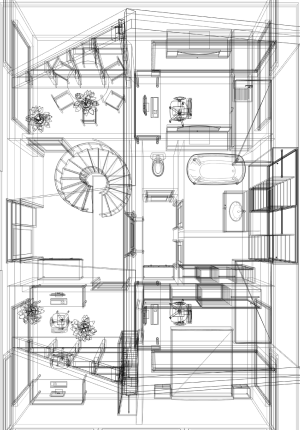
Commercial HVAC Case Study: A Tenant Fit-Out Project
The job most commercial tenants don’t see coming
A pet grooming spa signs a lease on a 1,716 square foot retail space in Utah, a typical commercial tenant fit-out HVAC project. The shell is built. The landlord is providing a packaged rooftop unit. The build-out drawings are nearly complete. Permit submission is days away.
Then the building department asks for the load calculations.
This is where most commercial tenant fit-outs hit their first real delay, and it’s the exact moment ProCalcs gets the call. The space looks simple from the outside. The HVAC reality underneath is anything but.
Here’s how a recent project came together, what the calculations actually told us, and why the technical details matter for any contractor, builder, or tenant taking on a commercial fit-out.
Project snapshot
| Project type | Commercial tenant fit-out (alteration) |
| Use | Pet grooming spa, retail occupancy classification |
| Conditioned floor area | 1,716 sq ft |
| State | Utah |
| Climate zone | 5b |
| Energy code | 2021 IECC |
| Mechanical code | 2021 Utah Mechanical Code |
| Zones designed | 12 (grooming, wash area, kennel, lobby, reception, restroom, kitchen, utility, hallways, quiet room) |
| Deliverables | Commercial load calculations (RTS method), equipment selection and verification, Manual D duct design, COMcheck envelope, lighting, and mechanical compliance, M-sheets (HVAC drawings) |
| Turnaround | 3 to 5 business days once complete project information was received |
The technical challenge, and why it wasn’t actually about the HVAC
When the project came in, the most pressing question wasn’t load or duct sizing. It was occupancy classification.
A pet grooming spa sits in a gray area. Is it retail? Is it an animal facility? The answer changes everything downstream in the mechanical design.
Why classification matters for HVAC:
Under the 2021 Utah Mechanical Code (Table 403.3.1.1), ventilation rates are tied to occupancy category. A retail sales space gets one set of values. A pet shop or animal-related area gets stricter exhaust requirements, including dedicated exhaust in grooming rooms and kennel areas at roughly 0.9 CFM per square foot, to control odors, dander, and humidity from wash activity.
As a result, that single classification decision can swing total exhaust requirements from a few hundred CFM to well over a thousand. And whatever air gets exhausted has to be replaced with conditioned outside air, which directly increases the heating and cooling load the equipment has to handle.
However, for this project, the building department confirmed retail classification. But the design still needed dedicated exhaust in the heavy-cleaning zones: grooming, wash area, and restroom, because that’s where the moisture and odor actually originate. The final design landed at 240 CFM of total exhaust distributed across those three areas (80 CFM each), with 294 CFM of outside makeup air balanced through the rooftop unit.
This is the part of commercial HVAC design that doesn’t show up on a residential job. You can’t size equipment without first knowing what code category you’re designing under.
The calculations that actually got submitted
Permit-ready commercial HVAC design isn’t one document. It’s a coordinated package, each piece grounded in a different ASHRAE or ACCA methodology. Here’s what we ran for this project and what each step actually does.
Commercial load calculations: RTS method
Method used: Radiant Time Series (RTS), per ASHRAE.
RTS is the modern ASHRAE-developed methodology for commercial load calculations. It accounts for the time delay between when heat actually hits a building surface and when it shows up as a cooling load on the equipment. That matters more than it sounds. A building with high thermal mass (concrete, masonry, slab-on-grade) absorbs heat during the day and releases it slowly, which can shift peak cooling loads by hours. RTS captures that. Older simplified methods don’t.
For light commercial projects up to 99 occupants and 15 tons per unit, RTS is the right tool. It’s more accurate than residential methods and more practical than the full ASHRAE 90.1 calculations used for large commercial buildings.
Specifically, for this space, the calculation produced:
- Total cooling load: 38,934 Btuh (about 3.25 tons)
- Latent cooling load: -3,265 Btuh (the space is net-dehumidifying, even with wash activity)
- Total heating load: 57,872 Btuh
Breakdown by component on the cooling side: walls 7.2%, glass 16.5%, ceilings 6.7%, infiltration 3.4%, ventilation 17.4%, ducts 6.1%, and internal gains 42.3%, the dominant load driver, which is typical for retail spaces with lighting, equipment, and people.
On the heating side, ventilation and humidification together accounted for 43.6% of the total. Climate Zone 5b winters are no joke, and pet grooming spaces lose a lot of conditioned air through exhaust.
Equipment selection and verification
The landlord had pre-selected a Lennox KGC092M packaged rooftop unit, a 7.5-ton gas and electric package with:
- 138,400 Btuh heating output (derated for altitude)
- 78,260 Btuh total cooling, 62,608 Btuh sensible (derated)
- 0 EER, 2,500 CFM nominal airflow
- 80% AFUE gas heat
- Existing AHRI reference 209319553
Equipment selection takes the load calculation output and verifies whether the proposed equipment is the right match, not just by capacity, but by sensible-to-total ratio, latent capacity, airflow, and external static pressure capability.
In this case, the existing 7.5-ton unit was correctly sized. Cooling capacity comfortably covered the 38.9 MBtuh load. Heating output of 138.4 MBtuh covered the 57.9 MBtuh design load with margin for recovery. The 2,500 CFM matched the duct design airflow.
This is the verification step that prevents one of the most common commercial HVAC failures. A landlord provides equipment that “looks about right” but is actually undersized for the tenant’s intended use, or, just as often, oversized, which creates humidity control problems and short-cycling.
Manual D: Duct design
Once the load is known and the equipment is verified, Manual D translates it into actual duct geometry: branch sizes, trunk sizes, friction rates, and total effective length.
For this project, the calculation produced:
- External static pressure: 70 in. WC available, 0.36 in. WC after losses (filters, diffusers, return grilles, balancing dampers)
- Friction rate: 090 in per 100 ft (well within ACCA-recommended ranges)
- Total effective length: 401 ft including fitting equivalents
- Supply trunks: Two main trunks (12×12 and 16×18 rectangular fiberglass) off a 28×20 system riser
- Return trunks: Sized for 2,500 CFM at 556 fpm, low velocity to keep return grilles quiet
- 15 supply branches sized from 4 inch to 12 inch diameter to deliver the room-by-room CFM requirements
The deliverable was a coordinated set of three mechanical sheets: general notes (M-1), full HVAC floor plan with grille schedule (M-2), and equipment schedules with installation details (M-3).
COMcheck: Energy code compliance
Separate from the load and duct design, every commercial project in Utah needs a COMcheck energy compliance report demonstrating the building meets 2021 IECC requirements. For this project, we ran:
- Envelope compliance: wall assemblies (2×6 framing with R-19 cavity plus R-5 continuous), roof (R-30), slab, windows (NFRC-rated with documented U-factor and SHGC), and doors. Result: PASSES.
- Interior lighting compliance: 1,716 SF retail space allowed 1,802 watts; proposed LED panel design used 342 watts. Result: PASSES with significant margin.
- Exterior lighting compliance: Zone 2 (light industrial). Result: PASSES.
- Mechanical compliance: equipment efficiency, fan power, economizer, ventilation controls. Result: PASSES.
Permit reviewers see a passing COMcheck and the energy compliance question is closed. That keeps the project moving.
The real-world test: a window tint change mid-design
Here’s something that doesn’t show up in textbook case studies. Design changes don’t stop when calculations are complete.
After the initial documents were issued, the client decided to apply a professional window tint film (a daylight-control product with specific U-factor and SHGC characteristics) to all windows. This is a common late-stage change in retail fit-outs, and one that almost always affects HVAC compliance.
The film changed the windows’ performance values, which changed the COMcheck envelope inputs, which required re-verification that the design still passed. We updated the SHGC and U-factor inputs to reflect the documented tint specifications, re-ran COMcheck, and re-issued the documents.
Total turnaround on the revision: same day.
This is the part of the design relationship that matters for contractors and tenants alike. Permit-ready calculations aren’t a one-and-done deliverable. They’re a living document until the project breaks ground, and sometimes after.
What contractors and tenants actually get
For any commercial fit-out under 99 occupants and 15 tons per unit, the package looks like this:
- Commercial load calculations (RTS method): room-by-room sensible and latent loads using the ASHRAE Radiant Time Series methodology
- Equipment selection and verification: sizing matched to actual load, not rule of thumb
- Manual D duct design: branch and trunk sizes, friction rates, static pressure analysis
- Full HVAC drawings: title-blocked, stamped M-sheets showing layout, grille schedules, equipment schedules, ventilation tables, and installation details
- COMcheck energy compliance: envelope, interior lighting, exterior lighting, and mechanical sections, all in a single submittable PDF
- Outside air and exhaust schedules: coded to the local mechanical code, ready for plan review
What we don’t do, and want to be straight about: ProCalcs is not an engineering firm. We produce permit-ready calculations and design documents. We do not sign or seal as engineers, submit permits directly to building departments, or perform physical HVAC installation. That work belongs to the licensed mechanical contractor and, where required, the engineer of record.
What we do handle is the technical foundation everyone else’s work depends on, done in 3 to 5 business days once we have complete project information.
Why this matters for the commercial work you’re considering
If you’re a contractor taking on more commercial tenant fit-outs, the calculation work is often where projects stall. You can self-perform if you have the time and the software, or you can hand it off and stay focused on installation. We work with contractors across the country exactly this way.
If you’re a building owner, tenant, or general contractor trying to get a commercial space permitted, the load calculations and energy compliance documents are non-negotiable for the building department. Getting them right the first time, and being able to revise them quickly when the design changes, is what keeps the permit moving and the lease commencement date intact.
Either way, the pattern is the same. Light commercial HVAC design is technical, code-driven, and unforgiving of shortcuts. But it isn’t slow. With complete project information in hand, a tenant fit-out package can be ready for submission in under a week.
Get a commercial HVAC design quote
If you have a commercial tenant fit-out, retail build-out, or light commercial project in design or pre-permit stage, send the plans to tom@procalcs.net for a quote. Typical turnaround is 3 to 5 business days from complete information to delivered package.
We work on light commercial projects up to 99 occupants and 15 tons per unit, including retail, office, restaurant, salon, veterinary, fitness, and similar tenant fit-outs in all 50 states.
Are you a contractor? Partner with us
If you’re a licensed HVAC contractor and you’d rather hand off the calculation and design work so your team stays on installation, the ProCalcs Partner Program is built for you. Reach out at tom@procalcs.net to learn more.